


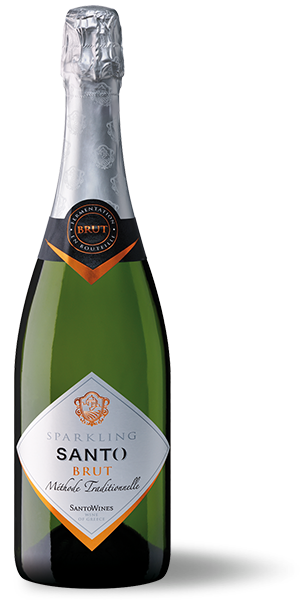
Santo Brut
Crystal-clear, with pale yellow-green color. Elegant with high quality mousse. The nose is expressive with white-peach notes, honey and hints of honeycomb. Round and balanced on the palate, with refreshing acidity that provides freshness and pleasant character, leading towards a long finish.
Early harvest grapes from Pyrgos village. After cooling them down at 5 οC, the grapes were pressed as quickly as possible and the juice was left to settle down. Primary fermentation took place, resulting in a base wine with a neutral flavor character, high acidity and just a moderate alcohol by volume, as in the case of champagne. The wine was stabilized and filtered and a proportion of liqueur de tirage was added to encourage the secondary fermentation. The wine was then closed with a crown cap and left to ferment and create the sparkle. The sparkling wine was left over a period of 19 months on the lees, in a process known as yeast autolysis.
PAIRS WELL WITH:
Seafood
Chicken with creamy sauces
Yellow cheeses
SERVED AT:
40-45 °F
DETAILS
COUNTRY
Greece
REGION
Santorini
LOCATION
Pyrgos
ALTIDUTE
1300 ft
WINE TYPE
Sparkling
STYLE
Dry
ALC BY VOL
11.6%
VARIETIES
Assyrtiko 100%
APPELATION
PDO Satorini
VINIFICATION
Primary fermentation, left over a period of 19 months on the lees, in a process known as yeast autolysis.
Santorini
Pyrgos
Light winters, rare rainfall, cool summer mild winds, known as “meltemia”. Additionally, the night sea mist created by the evaporation of the sea during the hot summer sunny days, works as a natural moisturizer for the plants. The orientation of the vineyards (facing north) and the altitude retain a lower average temperature throughout the year. Additionally, the sea mist created by the evaporation of the sea during the hot summer nights, works as a natural moisturizer for the plants. The salty spray that covers the grapes boosts minerality and adds a pleasant, slightly briny character to the wine.
The distinctive “aspa” of Santorini: a mixture of volcanic ash, pumice stone and pieces of solidified lava and sand. The soil has little to no organic matter, yet is rich in essential minerals (with the exception of potassium) leading to the production of wines with a naturally low pH level and a high acidity. The absence of clay offers a natural solid shield against phylloxera, which has never affected the vineyard of Santorini.
